Mooncake Store
As long-context LLM inference scales, GPU High Bandwidth Memory (HBM) rapidly becomes the primary bottleneck due to linear Key-Value (KV) cache expansion. Integrating Mooncake Store, host DRAM, and VAST Data creates a path that spills KV from GPU → DRAM → NFS, bypassing GPU memory bounds and cutting warm Time-To-First-Token (TTFT) when prefixes hit the DRAM and storage tiers. Mooncake Store replaces vLLM’s own DRAM pool and is controlled in a separate process, so the pool survives an inference engine crash. vLLM connects to that pool and does not hold it.
This guide details how to configure vLLM with Mooncake Store against high-performance VAST storage volumes over RDMA-enabled fabrics for production inference.
Prerequisites
Please make sure you have completed the File Prerequisites before starting this guide, as it can drastically impact performance.
Motivation
GPUs: The testing environment utilizes 2x NVIDIA RTX PRO 6000 Blackwell
Network:
The host is equipped with 2x Mellanox CX-7 200GbE Single-Port NICs
The network configuration for VAST storage is NFSv3 over RDMA
Storage: The team tested two primary configurations for KV cache offloading:
Local host: Mooncake DRAM pool, offload disabled
Remote VAST Data storage: the same pool, write-through onto a VAST partition via NFSv3 over RDMA, with NFS multipath
Software:
vLLM: Version 0.32.0
Mooncake: Version 0.3.14
NVIDIA CUDA: proprietary accelerated computing platform with programming models, compilers, libraries, runtimes, and deployment tools
Model: Llama-4-Scout-17B-16E-Instruct-FP8, TP-2
We evaluated a tp=2 configuration across concurrency levels, tuning the system according to the File Prerequisites guidelines to maximize performance:
nconnect: Set to 32
Mooncake Store configuration, detailed below
Results
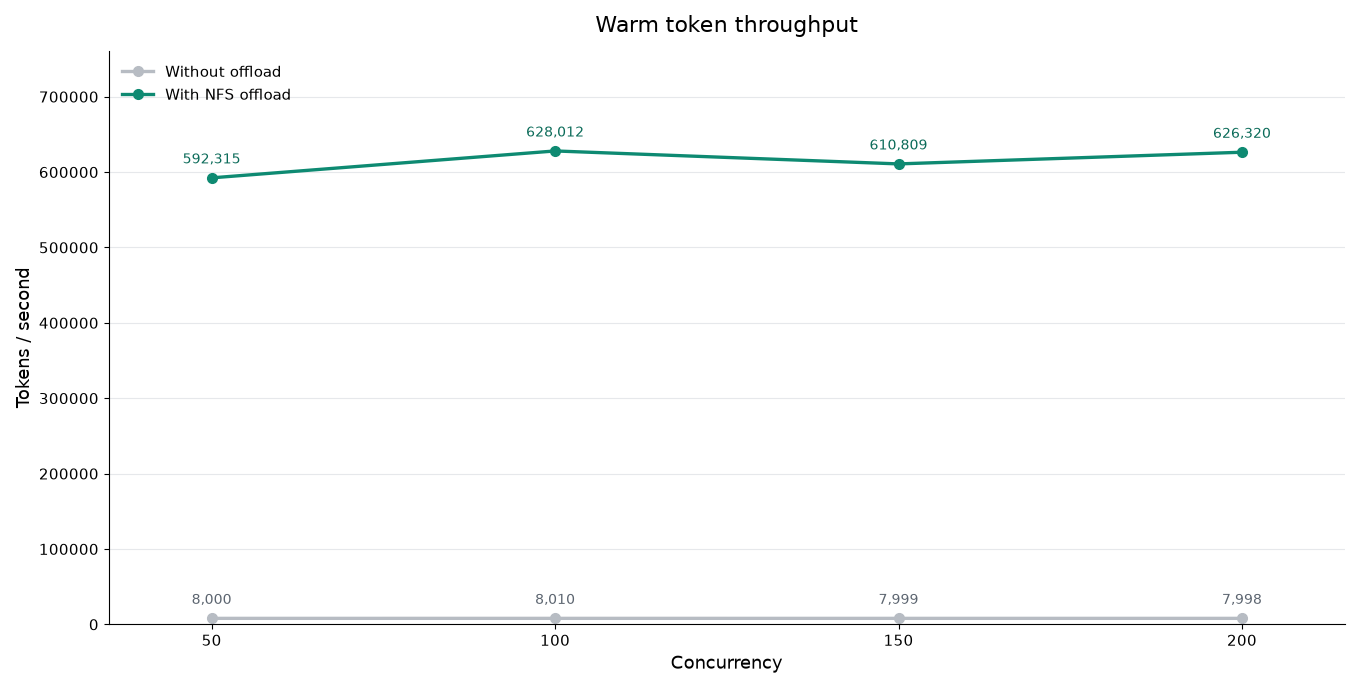
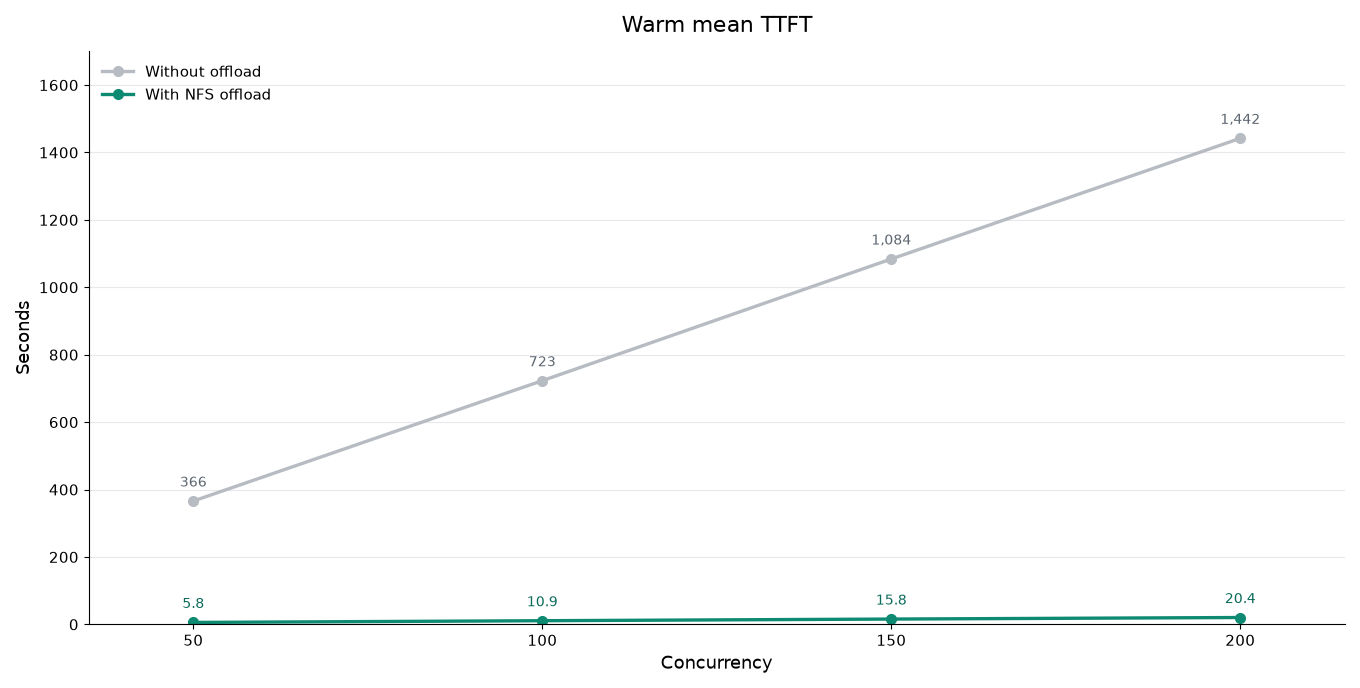
We measured warm TTFT and token throughput with a VAST storage backend and without, at concurrency 50, 100, 150, and 200. Both setups use the same DRAM pool. Without offload, the warm pass matches the cold pass.
Concurrency | Warm mean TTFT, no offload | Warm mean TTFT, NFS offload | Warm tok/s, no offload | Warm tok/s, NFS offload |
|---|---|---|---|---|
50 | 366 s | 5.8 s | 8,000 | 592,315 |
100 | 723 s | 10.9 s | 8,010 | 628,012 |
150 | 1,084 s | 15.8 s | 7,999 | 610,809 |
200 | 1,442 s | 20.4 s | 7,998 | 626,320 |
~74–78× warm tok/s
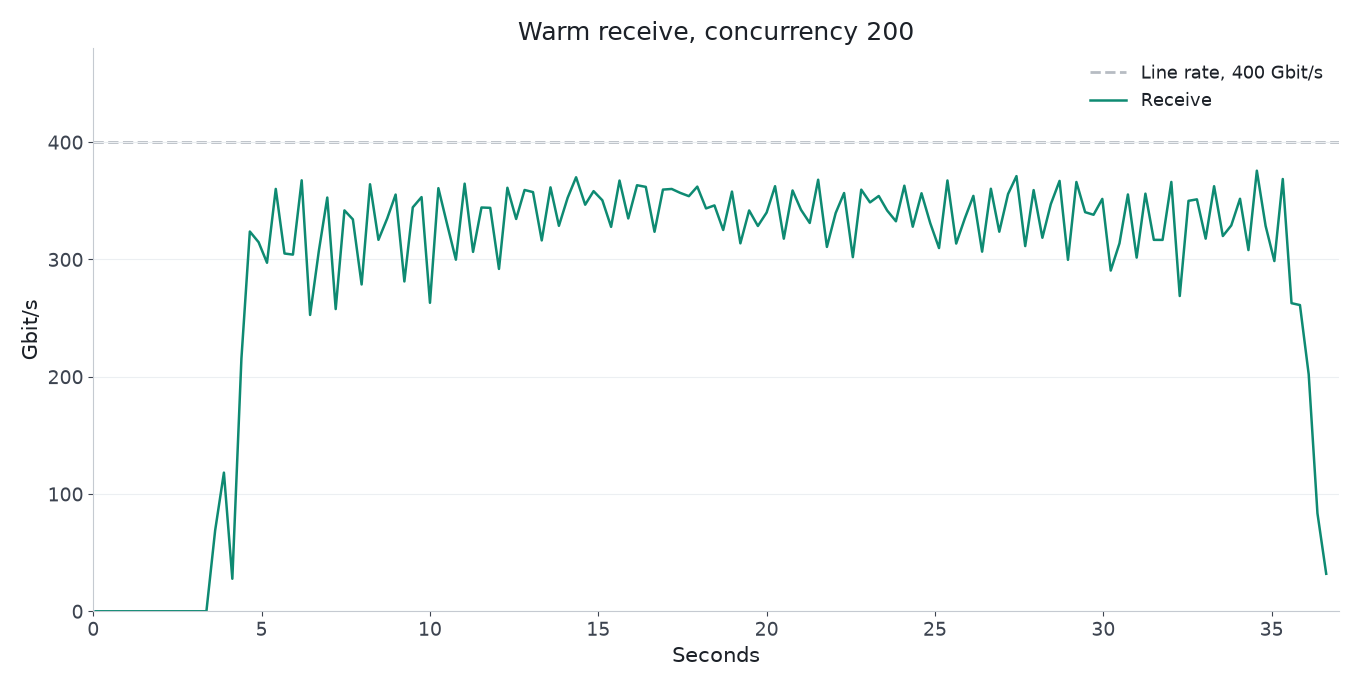
Warm NFS read, Concurrency 200. Mean receive 335 Gbit/s (~83% line-rate) while the read is on the wire, peak 376(~94% line-rate) - Line rate is 400 Gbit/s
~63–71× warm mean TTFT
Software Stack
We’ll be using the following NVIDIA Stack:
vLLM(*) - version 0.32.0, CUDA 12.9. Mooncake 0.3.14 is installed by the Dockerfile below.
Model -
nvidia/Llama-4-Scout-17B-16E-Instruct-FP8
Installation - NVIDIA
We’ll be working in the working directory /root/vastdata, and have cfg and models underneath it. We’ll also be using the /mnt/kvcache-2ports from earlier, so be sure you have this tree ready
BASE_DIR="/root/vastdata"
MODEL_DIR="${BASE_DIR}/models/llama-4-scout"
CACHE_DIR="/mnt/kvcache-2ports"
CFG="${BASE_DIR}/cfg"   # start.sh, mooncake.json, vllm_kv_transfer.json
mkdir -p ${BASE_DIR} ${MODEL_DIR} ${CFG} ${CACHE_DIR}/mooncake
Copy this package into ${BASE_DIR} (Dockerfile, cfg/start.sh, cfg/mooncake.json, cfg/vllm_kv_transfer.json, run.sh).
Downloading the model locally
python3 -m venv "${BASE_DIR}/.venv"
source "${BASE_DIR}/.venv/bin/activate"
pip install "huggingface_hub[cli]"
hf download nvidia/Llama-4-Scout-17B-16E-Instruct-FP8 \
  --local-dir "${MODEL_DIR}"
Why the Dockerfile builds Mooncake from source
The released Mooncake wheel hard-codes an io_uring queue depth of 32. The Dockerfile rebuilds mooncake-store/src/uring_file.cpp with QUEUE_DEPTH 255, the largest value the 8-bit completion index allows. That is the build behind the warm results above.
The source-built wheel links libgflags, glog, libjsoncpp, liburing, and libyaml-cpp dynamically. The release wheel bundled them, so the runtime stage installs those packages.
Use 0.3.14 or newer. That release keeps the tail partial bucket of each offload heartbeat. Earlier builds dropped it on write-through.
./cfg/mooncake.json
local_buffer_size is 4 GiB per rank. The DRAM pool is --global_segment_size on the owner client.
{
  "mode": "standalone-store",
  "metadata_server": "P2PHANDSHAKE",
  "master_server_address": "127.0.0.1:50051",
  "protocol": "rdma",
  "device_name": "",
  "global_segment_size": 0,
  "local_buffer_size": "4GB",
  "enable_offload": true
}
./cfg/vllm_kv_transfer.json
{
  "kv_connector": "MooncakeStoreConnector",
  "kv_role": "kv_both"
}
./cfg/start.sh
#!/usr/bin/env bash
set -euo pipefail

# The owner client rewrites mooncake.json onto a writable path. /cfg is mounted read-only.
PROTOCOL="rdma"
DATA_HOST="${MOONCAKE_DATA_HOST:-127.0.0.1:18001}"
DEVICE="${MOONCAKE_DEVICE:-}"
if [[ "$PROTOCOL" == "rdma" && "$DATA_HOST" == 127.* ]]; then
  ipaddr="$(ip -4 -o addr show scope global 2>/dev/null | awk '{print $4}' | head -1 | cut -d/ -f1 || true)"
  if [[ -z "$ipaddr" ]]; then
    echo "RDMA Mooncake needs MOONCAKE_DATA_HOST=<rdma-ip>:18001" >&2
    exit 1
  fi
  DATA_HOST="${ipaddr}:${DATA_HOST##*:}"
fi
if [[ "$PROTOCOL" == "rdma" && -z "$DEVICE" ]]; then
  DEVICE="$(find /sys/class/infiniband -mindepth 1 -maxdepth 1 -printf '%f\n' 2>/dev/null | paste -sd, - || true)"
fi
if [[ "$PROTOCOL" == "rdma" && -z "$DEVICE" ]]; then
  echo "no RDMA devices under /sys/class/infiniband; set MOONCAKE_DEVICE=mlx5_0,mlx5_1" >&2
  exit 1
fi
export MOONCAKE_DEVICE="$DEVICE"
python3 - <<'PY'
import json, os
from pathlib import Path
cfg = json.load(open("/cfg/mooncake.json"))
device = os.environ.get("MOONCAKE_DEVICE", "")
if device:
    cfg["device_name"] = device
Path("/tmp/mooncake.json").write_text(json.dumps(cfg))
PY

# Same-host RDMA: pin each HCA to the matching peer so mlx5_0 does not target mlx5_1.
export MC_STORE_MEMCPY=1
export MC_ENABLE_DEST_DEVICE_AFFINITY=1
export MOONCAKE_OFFLOAD_FILE_STORAGE_PATH="${MOONCAKE_OFFLOAD_FILE_STORAGE_PATH:-/kvcache/mooncake}"
export MOONCAKE_OFFLOAD_STORAGE_BACKEND_DESCRIPTOR=bucket_storage_backend
export MOONCAKE_OFFLOAD_USE_URING=1
export MOONCAKE_USE_URING=1
# 16 GiB owner buffer for the storage tier. This is not the per-rank local buffer.
export MOONCAKE_OFFLOAD_LOCAL_BUFFER_SIZE_BYTES=17179869184
export MOONCAKE_OFFLOAD_HEARTBEAT_INTERVAL_SECONDS=1
export MOONCAKE_OFFLOAD_FLUSH_PARTIAL_BUCKETS=1

mkdir -p "$MOONCAKE_OFFLOAD_FILE_STORAGE_PATH"
chmod 0777 "$MOONCAKE_OFFLOAD_FILE_STORAGE_PATH" 2>/dev/null || true

# Write-through: offload_on_evict=false copies KV to NFS as it is admitted.
mooncake_master \
  --rpc_port=50051 \
  --metrics_port=9003 \
  --enable_offload=true \
  --offload_on_evict=false \
  --offloading_queue_limit=500000 \
  --offload_cap_ratio=0.8 \
  --eviction_high_watermark_ratio=0.9 \
  --eviction_ratio=0.05 \
  --default_kv_lease_ttl=30000 &
MASTER_PID=$!

CLIENT=(
  mooncake_client
  --global_segment_size=180GB
  --master_server_address=127.0.0.1:50051
  --metadata_server=P2PHANDSHAKE
  --protocol=rdma
  --port=50052
  --enable_offload=true
  --threads=16
  --enable_http_server=true
  --http_port=9300
  --host="$DATA_HOST"
)
if [[ -n "$DEVICE" ]]; then
  CLIENT+=(--device_names="$DEVICE")
fi
"${CLIENT[@]}" &
CLIENT_PID=$!
cleanup() { kill "$CLIENT_PID" "$MASTER_PID" 2>/dev/null || true; }
trap cleanup EXIT

probe() { (echo > "/dev/tcp/$1/$2") >/dev/null 2>&1; }
for _ in $(seq 1 60); do probe 127.0.0.1 50051 && break; sleep 1; done
probe 127.0.0.1 50051 || { echo "mooncake_master failed readiness on :50051" >&2; exit 1; }
CLIENT_IP="${DATA_HOST%%:*}"
for _ in $(seq 1 60); do
  probe 127.0.0.1 50052 || probe "$CLIENT_IP" 50052 && break
  sleep 1
done
probe 127.0.0.1 50052 || probe "$CLIENT_IP" 50052 \
  || { echo "mooncake_client failed readiness on :50052" >&2; exit 1; }

KV_TRANSFER_CONFIG=$(python3 -c 'import json; print(json.dumps(json.load(open("/cfg/vllm_kv_transfer.json")), separators=(",", ":")))')
export MOONCAKE_CONFIG_PATH=/tmp/mooncake.json
export PYTHONHASHSEED=0
export VLLM_MOONCAKE_STORE_TIER_LOG=1
export VLLM_MOONCAKE_LOAD_RECV_THREADS="${VLLM_MOONCAKE_LOAD_RECV_THREADS:-4}"
# 4 GiB per rank (vLLM default). Host staging is 4 GiB times tensor-parallel size.
export MOONCAKE_LOCAL_BUFFER_PER_RANK_GIB="4"
export MOONCAKE_LOCAL_BUFFER_HOST_TOTAL_GIB="8"
export MOONCAKE_PREFERRED_SEGMENT="$DATA_HOST"

exec vllm serve /models/model \
  --host 0.0.0.0 --port 8000 \
  --served-model-name llama-4-scout \
  --tensor-parallel-size 2 \
  --max-model-len 131072 \
  --max-num-seqs 256 \
  --max-num-batched-tokens 8192 \
  --renderer-num-workers 8 \
  --gpu-memory-utilization 0.92 \
  --enable-prefix-caching \
  --block-size=64 \
  --kv-transfer-config "${KV_TRANSFER_CONFIG}"
./run.sh
#!/usr/bin/env bash
set -euo pipefail

BASE_DIR="/root/vastdata"
MODEL_DIR="${BASE_DIR}/models/llama-4-scout"
CACHE_DIR="/mnt/kvcache-2ports"
CFG="${BASE_DIR}/cfg"
IMAGE="${IMAGE:-vllm-mooncake:0.32.0-mooncake0.3.14-qd255}"
NAME="${NAME:-vllm-mooncake}"

# io_uring needs an unconfined seccomp profile. RDMA needs the InfiniBand device nodes.
RDMA_ARGS=()
for dev in /dev/infiniband/rdma_cm /dev/infiniband/uverbs* /dev/infiniband/umad*; do
  if [[ -e "$dev" ]]; then RDMA_ARGS+=(--device "$dev"); fi
done

mkdir -p "$CACHE_DIR" "${CACHE_DIR}/mooncake"
chmod +x "${CFG}/start.sh"

docker rm -f "${NAME}" >/dev/null 2>&1 || true
docker run --name "${NAME}" -d \
  --network host --ipc host --shm-size 128g \
  --ulimit memlock=-1 --ulimit stack=67108864 \
  --gpus all \
  -v "${MODEL_DIR}:/models/model:ro" \
  -v "${CACHE_DIR}:/kvcache:rw" \
  -v "${CFG}:/cfg:ro" \
  --security-opt seccomp=unconfined \
  --cap-add IPC_LOCK \
  "${RDMA_ARGS[@]}" \
  -e PYTHONHASHSEED=0 \
  --entrypoint bash "${IMAGE}" /cfg/start.sh

echo "started ${NAME}; logs: docker logs -f ${NAME}"
./Dockerfile
# vLLM 0.32 plus Mooncake Store (master and one owner client).
#
# vLLM 0.32 MooncakeStoreConnector does not read a filesystem path. Storage
# offload is the sidecar mooncake_client. vLLM runs in standalone-store mode
# and contributes no DRAM of its own.
#
#   docker build \
#     --build-arg BASE_IMAGE=<vllm-0.32.0-cuda-12.9-image> \
#     -t vllm-mooncake:0.32.0-mooncake0.3.14-qd255 .

ARG BASE_IMAGE
FROM ${BASE_IMAGE} AS mooncake-builder

# 0.3.14 is the first release that keeps the tail partial bucket of every
# offload heartbeat. Earlier builds dropped it on write-through.
ARG MOONCAKE_VERSION=0.3.14
ARG MOONCAKE_URING_QUEUE_DEPTH=255

# The released wheel hard-codes an io_uring queue depth of 32. 255 is the
# largest value Mooncake's 8-bit completion index supports.
RUN apt-get update \
 && DEBIAN_FRONTEND=noninteractive apt-get install -y --no-install-recommends \
      git libibverbs-dev librdmacm-dev libgflags-dev libgoogle-glog-dev \
      libnuma-dev libssl-dev libcurl4-openssl-dev liburing-dev \
      libyaml-cpp-dev libjsoncpp-dev libzstd-dev libxxhash-dev libboost-dev \
      pkg-config \
 && rm -rf /var/lib/apt/lists/* \
 && git clone --recursive --depth 1 --branch "v${MOONCAKE_VERSION}" \
      https://github.com/kvcache-ai/Mooncake.git /tmp/Mooncake \
 && sed -i \
      "s/static constexpr unsigned QUEUE_DEPTH = 32;/static constexpr unsigned QUEUE_DEPTH = ${MOONCAKE_URING_QUEUE_DEPTH};/" \
      /tmp/Mooncake/mooncake-store/src/uring_file.cpp \
 && sed -i \
      "s/version = \".*\"/version = \"${MOONCAKE_VERSION}+qd${MOONCAKE_URING_QUEUE_DEPTH}\"/" \
      /tmp/Mooncake/pyproject.toml \
 && python3 -m pip install --no-cache-dir scikit-build-core \
 && mkdir /tmp/wheels \
 && CMAKE_BUILD_PARALLEL_LEVEL=16 python3 -m pip wheel \
      --no-cache-dir --no-deps --wheel-dir /tmp/wheels /tmp/Mooncake

FROM ${BASE_IMAGE}
ARG MOONCAKE_VERSION=0.3.14
ARG MOONCAKE_URING_QUEUE_DEPTH=255

# The source-built wheel links these dynamically. The release wheel bundled them.
RUN apt-get update \
 && DEBIAN_FRONTEND=noninteractive apt-get install -y --no-install-recommends \
      libgflags2.2 libgoogle-glog0v6t64 libjsoncpp25 liburing2 libyaml-cpp0.8 \
 && rm -rf /var/lib/apt/lists/*

COPY --from=mooncake-builder /tmp/wheels/ /tmp/wheels/
RUN python3 -m pip install --no-cache-dir --force-reinstall --no-deps \
      /tmp/wheels/mooncake_transfer_engine-${MOONCAKE_VERSION}+qd${MOONCAKE_URING_QUEUE_DEPTH}-*.whl \
 && rm -rf /tmp/wheels \
 && python3 -c "import importlib.util; spec=importlib.util.find_spec('mooncake.store'); assert spec and spec.origin, spec" \
 && command -v mooncake_master \
 && command -v mooncake_client
Build the image & Run it
docker build \
  --build-arg BASE_IMAGE=<vllm-0.32.0-cuda-12.9-image> \
  --build-arg MOONCAKE_VERSION=0.3.14 \
  --build-arg MOONCAKE_URING_QUEUE_DEPTH=255 \
  -t vllm-mooncake:0.32.0-mooncake0.3.14-qd255 .

chmod +x cfg/start.sh run.sh
./run.sh
Additional resources
(*) While optimized, they are frequently not the latest vLLM builds
Final note
As workloads and software stacks frequently change, performance opportunities and compatibility shifts may occur. VAST actively expands its capabilities in the KV cache space—contact our team directly to leverage our latest updates and maximize your performance.